

Thanks to technological advances and a better understanding of biomechanics, a true paradigm shift is taking place in the management of musculoskeletal disorders. Muscle strengthening now plays a central role in the conservative treatment of many orthopedic conditions.
Developing and maintaining good muscle quality is essential for mobility. Muscle strength is the foundation of movement, contributes to joint stability, and helps absorb mechanical loads applied to joints.

It is well documented that a progressive decline in muscle strength begins as early as the age of 35 to 40. This loss of strength increases the risk of injury and falls and contributes to the early onset of degenerative joint changes. Our increasingly sedentary lifestyles only amplify this phenomenon.
The good news is that muscle strength and mass can be improved at any age, with a clear therapeutic benefit for many musculoskeletal conditions.
Muscle strengthening as a treatment
Muscle strengthening is not a new concept. As early as ancient times, Aristotle recognized its therapeutic value. The legend of Milo of Croton perfectly illustrates the principle of progressive overload.
Milo, a Greek athlete of the 6th century BC, is said to have carried a newborn calf on his shoulders every day while walking around his village. As the animal grew heavier, Milo’s strength and muscle mass increased accordingly. According to legend, he eventually carried a bull weighing more than 350 kg. This training method gave rise to the Greek proverb: “He who has carried a calf can also carry a bull” (Quae tulerit vitulum, illa potest et tollere taurum).
This fundamental principle — an adapted, progressive, and controlled load — remains at the core of modern conservative treatment today.
A new paradigm driven by technology
In clinical practice, several factors can limit the effectiveness of muscle strengthening programs: long-term motivation, quality of movement execution, respect for joint biomechanics, and the difficulty of objectively documenting progress.
These challenges are particularly common in non-athletic patients, but also in those suffering from joint or muscle pain related to early osteoarthritis, meniscal lesions, or other orthopedic conditions.
In this context, the motion analysis and strength-measurement technologies used at Dr.E by Swiss Ortho Clinic, the specialized rehabilitation center, allow for a precise and safe approach. Therapists perform objective assessments of joint range of motion and initial muscle strength, based on which a personalized, progressive, and pain-free strengthening program is established. When necessary, this program may be combined with manual and functional therapy.
Patients perform high-quality movements with precise control of speed and range, enabling effective muscle strengthening in a motivating and often playful way.
A clinical example
As part of a conservative treatment strategy recommended by his orthopedic surgeon, Mr. Ziorjen kindly agreed to share his experience after completing a specialized muscle strengthening program at Dr.E by Swiss Ortho Clinic.
At 70 years of age and very physically active — including skiing, ski touring, and mountain hiking — he presented with a degenerative meniscal lesion associated with significant muscle weakness that he had not suspected.
Isometric strength testing revealed a marked muscular deficit as well as a significant imbalance between the left and right sides and between flexor and extensor muscle groups. This finding came as a surprise to the patient given his high level of physical activity.
Objectively demonstrating these deficits proved to be a key motivational factor. The targeted strengthening program, performed without pain thanks to the controlled environment provided by the machines, allowed him to progress safely and efficiently.
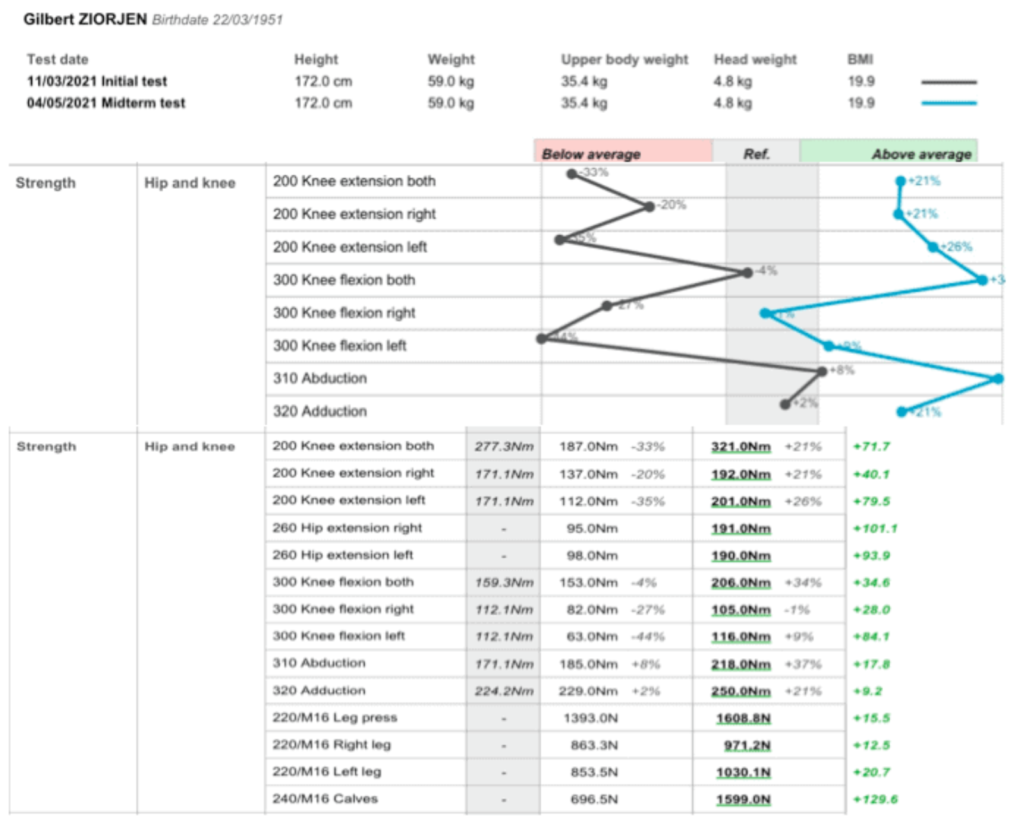
Results showed improvements in muscle strength ranging from 9% to 129%, depending on the muscle group assessed.
For the treating physician and orthopedic surgeon, the follow-up report confirmed that the patient completed all rehabilitation sessions with a high level of execution quality and a compliance rate exceeding 80%. Functional questionnaires such as the IKDC and KOOS were also used to document clinical progress.

A scientific and personalized approach
Only a targeted protocol combined with personalized technological monitoring can ensure an effective and scientifically documented rehabilitation process. This approach, known as Exertherapy, is based on individualized therapy through controlled movement, as implemented at Dr.E by Swiss Ortho Clinic.
Muscle strengthening is therefore not a miracle solution, but it represents an optimal treatment strategy for many musculoskeletal conditions. It may be used as a stand-alone conservative treatment or, in certain cases, as a complement to surgical management.
It is also important to note that some degenerative meniscal lesions may have unfavorable outcomes following surgical treatment. Arthroscopy with partial meniscectomy is only indicated after failure of a well-conducted conservative treatment and in the presence of clinical signs consistent with mechanically induced pain.
